Owner-led project management1-business-day responseLicensed General, Marine, Electrical & Plumbing Contractor Boca Raton · Palm Beach · Broward
Marine Construction · Boca Raton, FL

Seawalls engineered for the next thirty years.

Owner-led seawall design and installation across Palm Beach and Broward Counties. Composite vinyl walls recommended, traditional concrete available — built to the 2035 and 2050 NAVD88 height code. Every Florida trade license held in-house. One company, one accountability chain, one phone number.

Workmanship warranty 8 years Leading in Florida
Trade licenses Marine · General · Electrical · Plumbing All four held in-house
Permit to install 180 days Standard project commitment
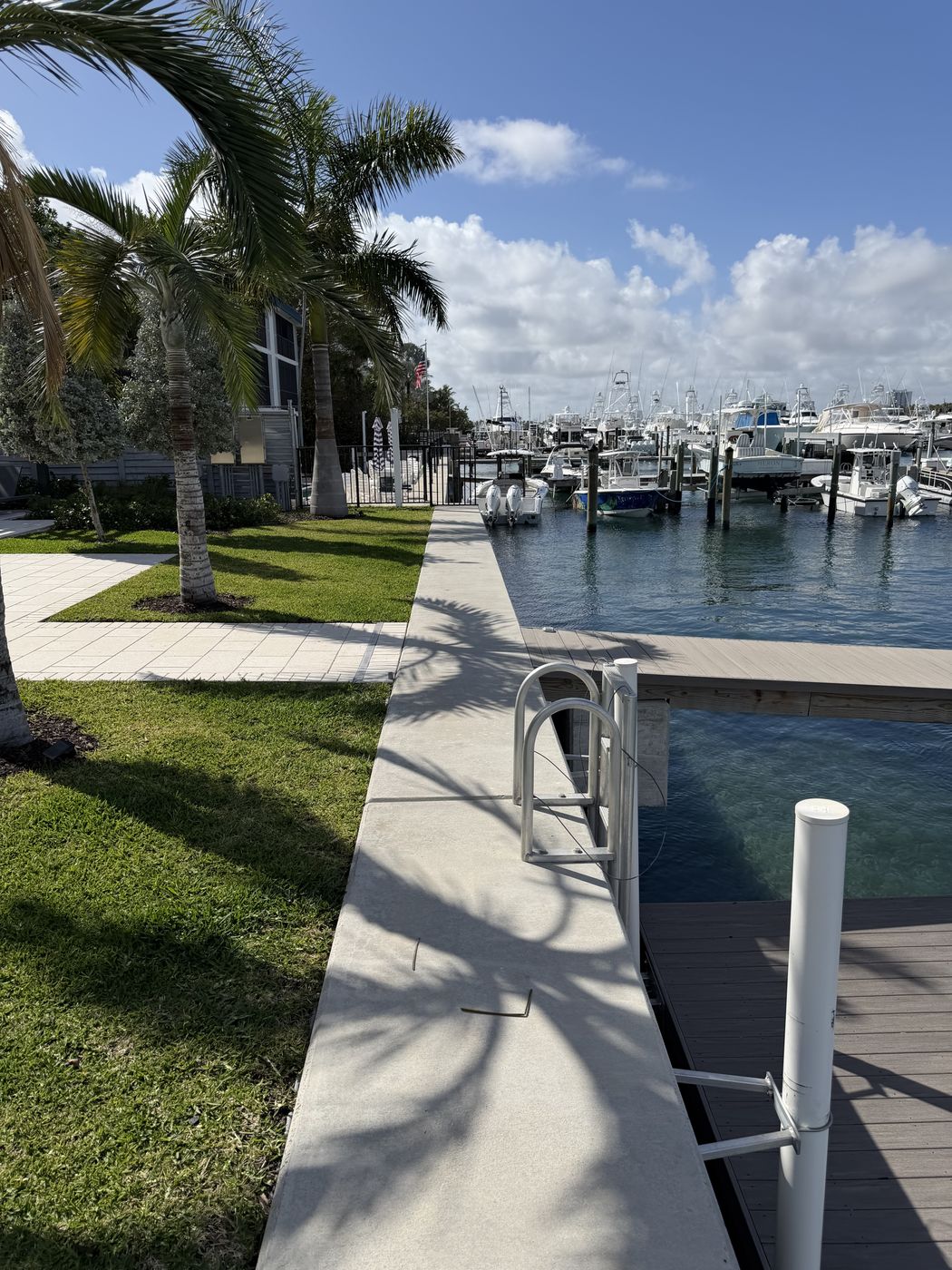
Modern luxury waterfront home in Boca Raton with engineered seawall and dual boat lifts
RESIDENTIAL · BOCA RATON · INTRACOASTAL 26.36° N · 80.13° W
Florida-Licensed Marine · General · Electrical · Plumbing
8-Year Workmanship Warranty Leading in Florida
Permits Filed In-House
Staged Progress Billing No large upfront payment
Truline Authorized Dealer
Permit to Install 180-day standard
Request an evaluation

An owner reviews every inquiry.

Expect a response within one business day with available site-visit times. We come to the property, measure existing conditions against current and future code, and walk you through the options in person — vinyl, concrete, repair, or replacement.

No high-pressure sales. No call center. No shared lead lists.

Already have plans or an engineer's report?

Send it with your inquiry. We can scope from your documents and confirm dimensions, depths, and tieback geometry during the site visit.

How we operate

A different kind of marine contractor.

Most seawall companies hold one license, sub the rest, rent their equipment, and pour whatever they've poured for thirty years. We built the alternative — six ways.

01

Composite walls outlast everything.

We recommend Truline-style composite seawalls — a vinyl shell over a concrete-filled core — because they get the best of both materials. The vinyl exterior won't corrode, won't spall, and won't fade. The concrete core delivers structural mass. Independent testing supports 75+ year service life with effectively zero maintenance cost. Traditional concrete is available when an application calls for it.

02

Every trade in-house.

Marine, general, electrical, plumbing — every Florida license your project requires is held by the same company. One contract. One insurance certificate. One schedule. Nobody points fingers because nobody else is involved.

03

Permits handled. Not outsourced.

City of Boca, Broward and Palm Beach County, HOA architectural review, FDEP, engineering drawings, surveys — drafted, stamped, and filed by our team. You sign one document. We do the rest.

04

Our barge. Our crew.

Most contractors rent their barge and wait their turn. We own ours — and it fits under the fixed bridges on the New River and the residential canals, so we reach properties other contractors can't. No scheduling delays waiting on rented equipment. No subcontracted crews you've never met. The truck that pulls up to your dock is ours.

05

Built on this coastline.

The company is owner-led and locally operated. We know the soil profiles, the tide cycles, the permit reviewers, and the failure modes — because we've worked through them on this exact coastline, not somewhere else. South Florida is the only market we work in.

06

Storm response, built in.

Storm damage, partial wall failure, and active soil loss get prioritized over standard scheduling. For documented emergencies we move you to the front — typically an owner on site within 24 to 48 hours for assessment, with emergency shoring or tarp if needed, followed by the engineered repair on a permit-ready timeline.

By Design

Built to a spec, not a price.

Every seawall we build is an engineered structure — not a stock product dropped in front of a property line. Pile depth set for the soil. Cap elevation set for the 2050 code, not the 2010 code. Anchorage geometry (deadman, helical, or batter pile) calculated for the actual lateral load the wall will see. Drainage and filtration set for the hydrostatic pressure behind it.

This is what a composite seawall actually looks like in section — vinyl shell at the waterline, concrete-filled core inside, reinforced cap on top, deadman tieback or batter pile driven into competent soil beyond the wall.

  • Cap elevation+5.0 ft NAVD88
  • Sheet pileComposite (Truline)
  • AnchorageDeadman, helical, or batter pile
  • EmbedmentEngineered per soil
CAP +5.0 NAVD88 · 2050 +4.0 NAVD88 · 2035 MHW MUDLINE DEADMAN TIEBACK COMPOSITE SHEET PILE EMBEDMENT DEPTH CONCRETE CAP CROSS-SECTION COMPOSITE SEAWALL SCALE: REFERENCE
Why we recommend composite

The anatomy of a failed concrete seawall.

Every traditional concrete seawall in South Florida fails the same way. Rebar sits in chloride-rich saltwater for decades. Eventually it corrodes, expands, and cracks the concrete from the inside out — that's spalling. It's why nearly every old concrete seawall on the Intracoastal is cracked, bowing, or losing its cap.

A composite wall — vinyl exterior, concrete-filled core (Truline and similar systems) — solves the failure mode. The vinyl shell is the saltwater barrier. The concrete sits inside, never exposed to chloride, never corroded. Same structural mass. None of the corrosion path.

Traditional concrete still wins on commercial loads, certain deep-water installations, and HOA aesthetic specs. When it's the right answer, we pour it. When it isn't, we say so.

  • Yr 0–10Concrete looks fine. Chloride ions begin penetrating the cap and panels.
  • Yr 10–25Rebar corrosion accelerates. Hairline cracks become visible at the cap.
  • Yr 25–40Spalling begins. Concrete cover delaminates. Structural capacity drops.
  • Yr 40+Replacement required. A composite wall at the same age looks identical to day one.
YEAR 0–10 INTACT YEAR 10–25 HAIRLINE CRACKS YEAR 25–40 SPALLING CONCRETE · YR 40+ REPLACE CONCRETE CORE VINYL SHELL EXTERIOR COMPOSITE · YR 40+ INTACT vs FIG. 01 — CONCRETE SEAWALL FAILURE PROGRESSION SOUTH FLORIDA SALTWATER · CHLORIDE-DRIVEN REBAR CORROSION
Field Evidence

The same wall, four years apart.

Four photographs from recent site inspections in our service area — covering the full failure progression from first visible signs to structural separation. The diagram above is the theory. Below is the wall, the cap, and the water, as the years actually find it.

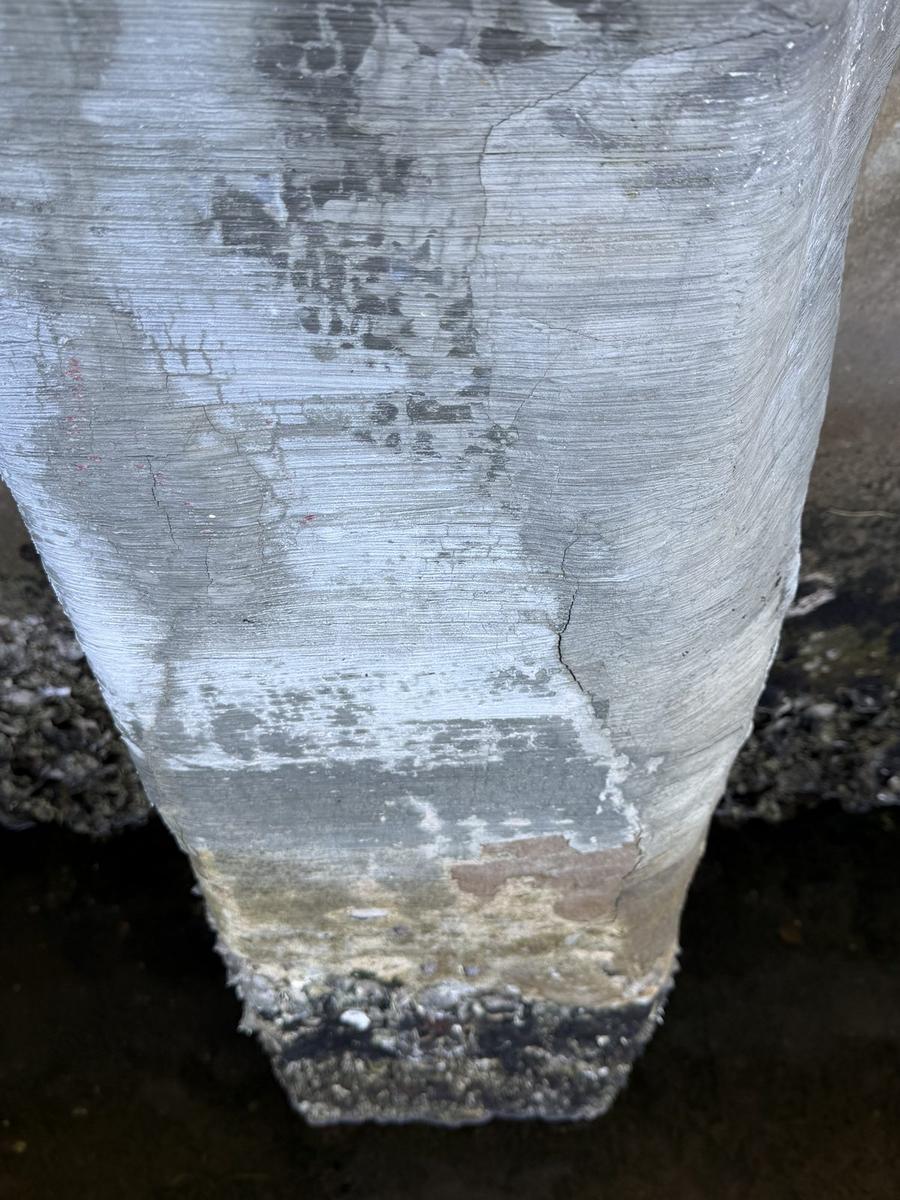
Concrete piling at the waterline showing surface delamination, calcium leaching, and early rust bleed at the rebar line
Stage 1 · Yr 10–25 FIG. 02 · CONCRETE PILING · WATERLINE
Observed condition

Calcium leaching, surface scaling, and the first signs of rebar.

A concrete piling at the splash zone. The pinkish stains running vertically are early rust bleed from the rebar inside. White patches are calcium hydroxide leaching out through the cracks. The surface is no longer continuous concrete — it's the start of delamination.

  • Calcium leaching at multiple bands — moisture moving through the matrix
  • Vertical pink/red streaks — rust products from corroded reinforcement
  • Marine growth at base marks mean high water — the most aggressive zone
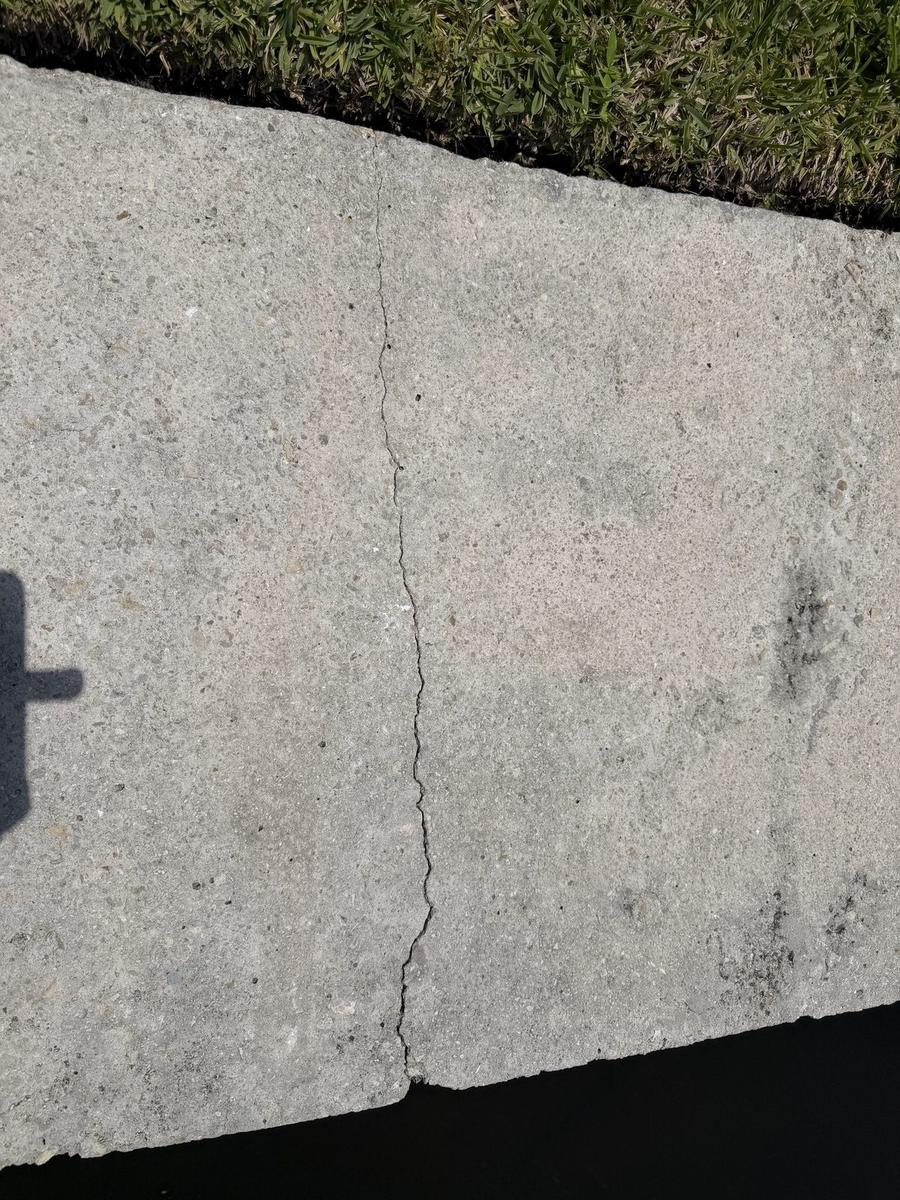
Vertical hairline crack running top to bottom on a concrete seawall cap, widening at the cap edge
Stage 2 · Yr 20–30 FIG. 03 · CONCRETE CAP · HAIRLINE FRACTURE
Observed condition

The first hairline crack is never the last one.

A vertical hairline crack running the full height of a concrete seawall cap. Width is still under 1mm — small enough to dismiss. But the crack reaches the cap edge at the bottom, where it widens. Moisture has a clear path to the rebar, and the corrosion clock has started.

  • Crack continuous from top to base — full-section penetration
  • Slight widening at lower edge — confirms moisture infiltration
  • No visible spalling yet — between Stage 1 and Stage 2 above
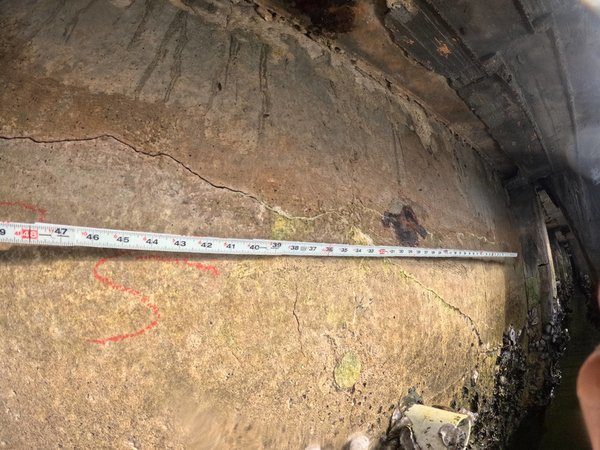
Measured horizontal crack across a concrete seawall face with field-survey markings
Stage 3 · Yr 25–35 FIG. 04 · CONCRETE FACE · STRUCTURAL CRACKING
Observed condition

Structural cracking. Documented and measured.

Tape stretched across a horizontal crack running the full visible length of the wall face — measured during inspection. The red field markings flag failure zones for engineering review. Cracks at this scale aren't surface defects: they're the wall telling you the rebar has corroded enough to lose tensile capacity.

  • Horizontal crack extends past the 47" measurement line — structural, not cosmetic
  • Field survey markings indicate documented inspection in progress
  • Spalling visible at multiple points along the crack edge
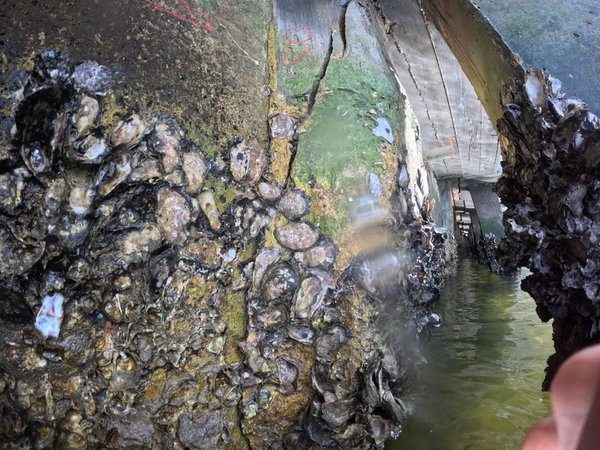
Catastrophic cap separation at a concrete seawall with extensive oyster colonization and visible structural void
Stage 4 · Yr 35+ FIG. 05 · CONCRETE CAP · STRUCTURAL SEPARATION
Observed condition

End of service life. Replacement is no longer optional.

The cap has sheared from the wall. Daylight is visible through what should be a continuous structural joint. Extensive oyster colonization confirms decades of exposure. Once a wall reaches this stage, no repair gets it back — the only path forward is full removal and a new wall.

  • Cap-to-wall separation visible — structural integrity has failed
  • Heavy oyster growth — confirms 30+ years of saltwater exposure
  • Algae streaking behind cap line — soil and water moving through the void

Every concrete seawall in South Florida moves through these stages on the same clock. The only variable is how soon. A composite wall installed today never starts the progression — because there's no rebar inside the saltwater barrier to corrode in the first place.

Materials

Three approaches. One honest recommendation.

We do not have a preferred margin. We have a preferred outcome — the wall that's still doing its job in year fifty. That's why we lead with composite. When traditional concrete is the right answer, we say so.

02
Traditional Concrete
Poured · Pre-cast panels

Right answer on certain commercial loads, deep-water installations, and HOA aesthetic specs that mandate it. Built with epoxy-coated rebar and proper concrete cover, a concrete wall remains a 30 to 40-year asset — though with the inherent chloride corrosion path that a composite wall avoids.

  • Service life 30–40 yr
  • Rebar treatment Epoxy-coated
  • Best use Commercial
  • Color Concrete grey
  • Typical install 3–5 wk
03
Cap & Repair
Tiebacks · Batter Piles · Voids

Not every wall needs replacement. Cap restoration, deadman tiebacks, helical tiebacks, batter piles for leaning walls, polyurethane void filling, and jet filter installation often add 10–20 years to an existing wall at a fraction of replacement cost.

  • Cap restoration
  • Tiebacks & batter piles
  • PU void fill
  • Jet filters
The Truline System

A wall made two ways at once.

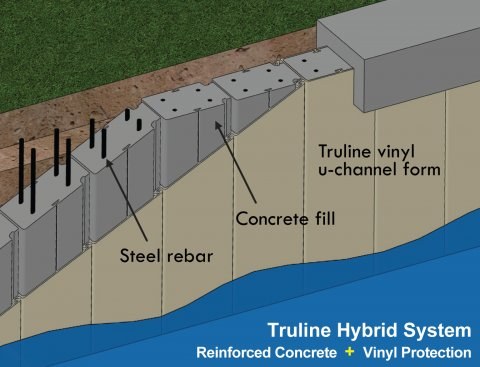
The Truline Hybrid System combines a reinforced concrete core with a vinyl exterior protection layer. The concrete provides the structural mass. The vinyl shields it from saltwater, UV, and abrasion. Neither one of those materials alone would do the job for fifty years on this coastline — together, they're the wall we recommend.

Truline Hybrid System diagram showing vinyl u-channel form, steel rebar, and concrete fill construction
How it works

Vinyl form, steel rebar, concrete fill.

Vinyl U-channel panels interlock vertically to form the wall face. Steel rebar drops into each cell. Concrete is poured to fill the cells, encapsulating the rebar inside the vinyl shell — fully sealed from saltwater.

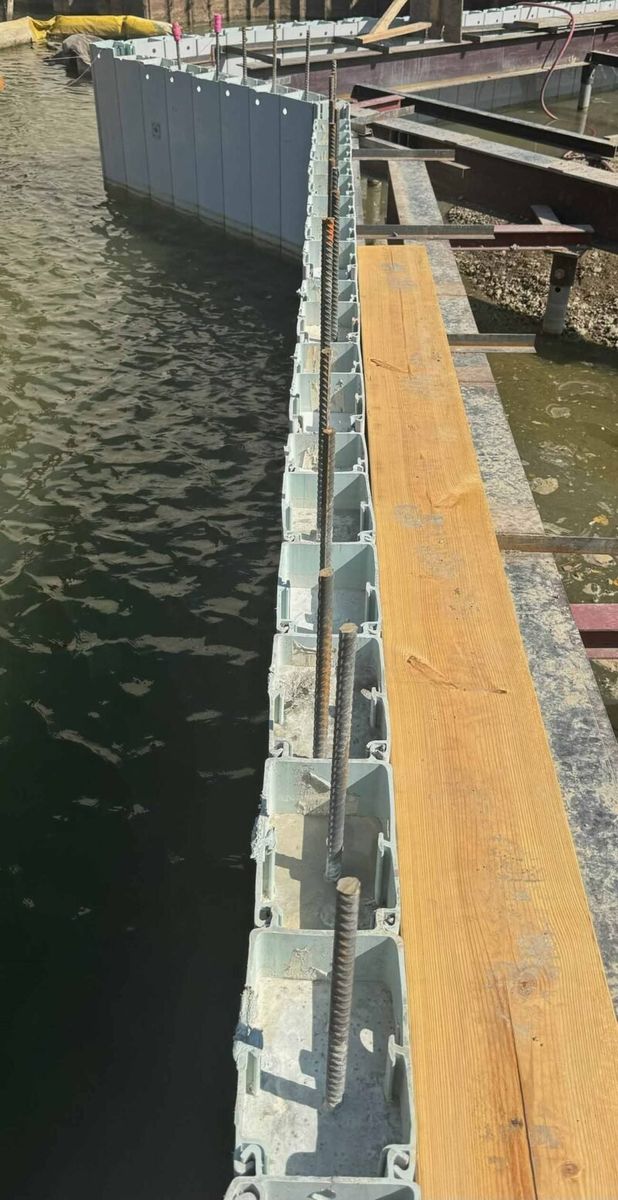
Truline vinyl seawall cells with steel rebar in place, before concrete pour
During installation

Rebar set. Pour next.

A live Truline install with the vinyl cells driven into position and rebar set vertically through each cell. The concrete pour fills these cells from below the cap down to embedment depth.

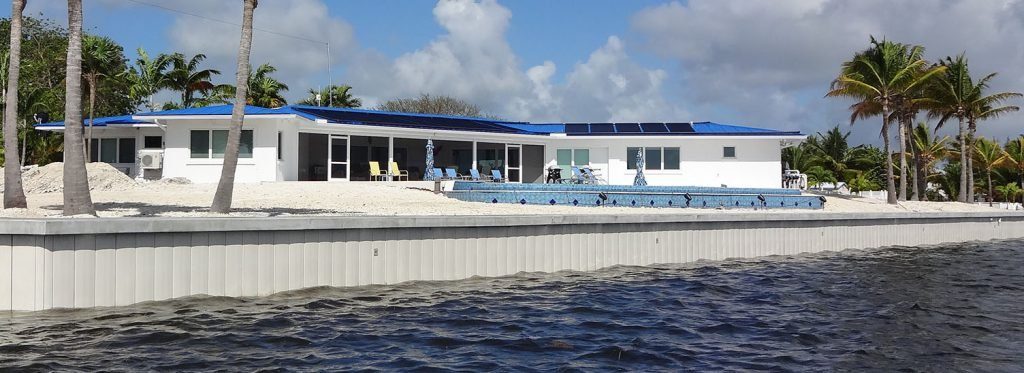
Completed Truline composite seawall protecting a luxury waterfront residence in South Florida
In service

Florida waterfront. For the long term.

A finished Truline wall protecting a South Florida residence. The vinyl face is UV-stable, color-stable, and won't spall or rust-stain — what you see at install is what you see in year forty.

Service life 75+ yrs Documented by independent testing
Maintenance cost $0 No painting, sealing, or rebar work
Manufacturer warranty 30–50 yr Material-specific, fully transferable
Color options Multiple Vinyl exterior — not concrete grey

Boca Seawall is an authorized Truline dealer. We install the system directly — no middleman, no resale margin, manufacturer warranty registered in your name.

Diagram and specifications courtesy of Truline ® · Truline is a registered trademark of its manufacturer

Pricing — Reference Ranges

No estimates over the phone. But no mystery either.

Every project is bid from a site visit. Material choice drives most of the variance — vinyl is cheapest to install, concrete sits in the middle, and composite (Truline) is the premium option. Final pricing depends on wall height, water depth, soil, access, anchorage, and demolition scope. We aim to deliver your project — from signed contract through final inspection — within 180 days.

Scope
Typical Range
Timeline
Notes
Vinyl sheet pile seawallVinyl only, no concrete core
$700 – $1,100 / LF
6–12 weeks
Lowest install cost. Good for sheltered canals, lower walls, lighter loads. Service life typically 40–60 years.
Traditional concrete seawallPoured-in-place or pre-cast
$900 – $1,400 / LF
10–16 weeks
Mid-range install cost. Service life 30–40 years in saltwater before spalling. Right call on commercial loads or HOA-mandated material spec.
Cap-only restorationExisting wall preserved
$300 – $600 / LF
2–4 weeks
When the wall panels are sound but the cap is cracked or below new code elevation.
Tiebacks & batter pilesDeadman, helical, or batter pile
$2,500 – $5,000 / unit
1–3 weeks
For walls leaning outward or rotating. Typically installed every 6–10 feet along the wall.
Void fill & jet filtersPolyurethane injection
$8,000 – $25,000
3–7 days
When soil behind the wall has washed out. Often catches a wall before full replacement is needed.
▲ Ranges current as of 2026 · do not include FDEP permit fees, HOA review fees, or engineering when not already in hand · ranges assume standard access · barge mobilization, oceanfront work, or restricted lots may shift quotes outside these bands.
Why composite is the recommended option

Most expensive to install. Cheapest to own.

Vinyl only ~50 yr life $900/LF ÷ 50 yr $18 / LF / yr
Traditional concrete ~35 yr life $1,150/LF ÷ 35 yr $33 / LF / yr

The composite wall costs roughly 30–60% more up front than vinyl or concrete. Over its service life, it's cheaper per year than concrete and roughly comparable to vinyl — while delivering the longest documented service life and the lowest maintenance cost of any of the three materials.

Recent Work

Engineered for this coastline.

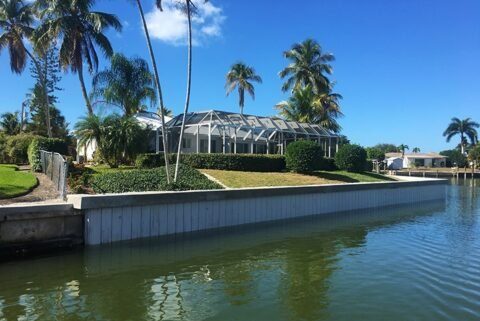
Seawall installations and repairs across Palm Beach and Broward County waterfront. Every project sized, sited, and built for the specific shoreline, soil, and tidal exposure where it lives.

The Process

From first call to final inspection.

Most seawall projects run eight to sixteen weeks. Permit processing is the long pole. Installation, once mobilized, is typically two to four weeks for residential replacement work.

i.

On-site evaluation

We come to your property. Measure cap elevation against NAVD88, assess wall condition, soil behind, water depth, access. An owner is on site.

~ 60 min
ii.

Engineering & quote

Material recommendation and pile depth based on soil and load. Written quote with line items — not a one-page lump sum. Drawings produced if needed.

5–10 days
iii.

Permits & install

We file City, County, HOA, and FDEP submittals. When install runs, every trade — marine, electrical, plumbing — is our crew. Our barge.

6–12 wk
iv.

Inspection & warranty

Final inspection, walkthrough, manufacturer warranty registration, and our 8-year workmanship warranty. One number to call for anything after.

Day of
Verified Reviews

What our clients actually say.

Pulled live from our service platform. Reviews are unfiltered — there is no editorial layer between client and screen.

Service Area

Palm Beach & Broward Counties.

From Hillsboro Mile to Highland Beach. Royal Palm Yacht Club to Lake Boca. We serve waterfront property across the South Florida coastline — Intracoastal, residential canals, and ocean access alike.

Boca Raton Highland Beach Delray Beach Boynton Beach Ocean Ridge Hillsboro Beach Hillsboro Mile Deerfield Beach Lighthouse Point Pompano Beach Lake Boca Royal Palm Yacht Club
Coverage 77+ mi Of South Florida waterfront
Base of operations Boca Raton Most work within 30 min
Beyond Seawalls

Boat lifts, docks, dredging — same company.

Boca Seawall is a South Florida Seawall company — a licensed marine general contractor handling boat lift installation, dock construction, dredging, and full waterfront construction across Palm Beach and Broward Counties.

Visit sflseawall.com
Why Boca Seawall

Different on purpose. Different on paper.

Most South Florida seawall companies hold one trade license, sub the rest, and pour whatever they've poured for thirty years. Here is what makes the comparison concrete.

Capability
Boca Seawall
Typical Marine Contractor
Trade licenses held in-house
Marine, General, Electrical, Plumbing
Marine only — subs the rest
Barge & crane
Owned — fits under fixed bridges
Rented — wait for availability
Local focus
South Florida only — Palm Beach & Broward
Generalist or out-of-area
Project contact
An owner reviews every inquiry
Salesperson on commission
Material recommendation
Composite-first, honest reasons
Whatever the company stocks
Permitting
Drafted, stamped, filed in-house
Outsourced to expediter
Workmanship warranty
8 years
1–2 years typical
Truline authorization
Authorized dealer
Often resells through a middleman
Payment structure
Staged progress billing
Large deposits, sometimes 50% up front
Project scope
Seawall + dock + lift + electrical in one contract
Three contracts, three crews, three schedules
Response time
1 business day
Call back when convenient

Most clients call us because their previous contractor disappeared between phases. We built the company to make that impossible.

Common Questions

Honest answers, before you sign.

The questions waterfront homeowners actually ask before they choose a seawall contractor.

How much does a seawall cost in Boca Raton?
Most residential seawall replacements in Boca Raton run between $900 and $1,800 per linear foot installed, depending on wall height, pile depth, cap design, water depth, access, and whether tiebacks are required. A typical 100-foot residential composite (vinyl + concrete-filled) seawall runs $90K–$140K; traditional concrete generally costs more on install and substantially more over the life of the wall. Cap-only repairs and tieback installations are significantly less. See the pricing table above for current ranges. We provide a free written quote after an on-site evaluation — no estimates over the phone, because every wall is different.
Why do you recommend composite over concrete?
Because of how traditional concrete seawalls fail in saltwater. The rebar inside a concrete wall sits in a chloride-rich environment for decades. Eventually it corrodes, expands, and cracks the concrete from the inside out — what's called spalling. That's why nearly every concrete seawall in South Florida starts showing structural distress between year 25 and year 40.

A composite wall — vinyl exterior over a concrete-filled core (Truline and similar systems) — solves the failure mode. The vinyl shell is the saltwater barrier. The concrete sits inside, never exposed to chloride, never corroded. Independent testing supports 75+ year service life with effectively zero maintenance cost. Traditional concrete still wins on commercial loads, certain deep-water installations, and HOA-specified aesthetics — and we install it when the application calls for it.See "Failure Anatomy" above for the year-by-year progression of how concrete walls fail in this market — and how a composite wall at the same age looks identical to day one.
How long does a seawall last?
Properly engineered and installed: composite (vinyl + concrete-filled core) is rated for 75+ years; traditional concrete typically delivers 30 to 40 years in South Florida saltwater before structural restoration is needed. Both fail earlier when they're under-engineered, when soil behind the wall washes out for years before anyone notices, or when nobody installs jet filters or weep holes to relieve hydrostatic pressure. The single biggest predictor of seawall life isn't material — it's how well the install handled the things behind and below the wall.
Do I need to comply with the new NAVD88 cap height rules?
Yes, and the deadlines matter. Broward County requires minimum seawall cap elevations of 4.0 ft NAVD88 by 2035 and 5.0 ft NAVD88 by 2050. Fort Lauderdale has already moved to 5.0 ft. Boca Raton and Palm Beach jurisdictions are tracking similar regulatory direction. If your wall doesn't meet the current code at replacement, you'll be required to bring it up — which means either a taller cap or a fully new wall. We measure your existing elevation against current and future code on the first site visit, and design accordingly.
What does a composite seawall cost to maintain?
Effectively zero structural maintenance cost over its service life. The vinyl shell is UV-stable and won't fade, won't corrode, and won't spall. There's no painting, no sealing, no rebar replacement, no cap rebuild. Periodic visual inspection — same as any wall — and that's the whole list. Compare that to a concrete wall, which typically needs cap repair somewhere between year 15 and year 25, full restoration around year 30, and replacement in the 30–40 year range.
Do I need a permit for seawall work in Boca Raton?
Yes — always. City of Boca Raton requires a marine construction permit for new seawalls, cap replacements, and most repair work. Depending on your shoreline, you may also need Palm Beach County, FDEP (Florida Department of Environmental Protection), and Army Corps of Engineers review — especially if you're oceanfront, on the Intracoastal, or in an environmentally sensitive area. HOA architectural approval is separate and often parallel. We handle the full permitting process in-house and strive to deliver every standard project from signed contract through final inspection within 180 days. Permitting alone runs 4 to 12 weeks depending on jurisdiction and engineering review.
Can you repair my existing seawall instead of replacing it?
Often, yes — and we'll tell you honestly which is the better call. If your wall has cap cracking, voids behind it from soil washout, or is leaning slightly outward from missing tiebacks, repair work usually solves it: cap restoration, polyurethane void filling, deadman or helical tiebacks, and jet filter installation. If the wall is structurally compromised — major spalling, exposed rebar, panels failing, or significant outward rotation — replacement is the answer. The site visit tells us which.
How long does the actual install take?
For a typical 100-foot residential seawall replacement, expect 2 to 4 weeks of active install once permits are issued and materials are on site. Full project timeline from first site visit to completed install runs 8 to 16 weeks, driven primarily by permit processing. Cap-only work and tieback installs are faster — often 1 to 2 weeks of field work.
What's the warranty?
Composite systems carry manufacturer warranties on the sheet pile — typically 30 to 50 years depending on product, with documented service life beyond 75 years. Traditional concrete carries no factory warranty by nature of the material. Across both, we warrant our installation workmanship for 8 years — substantially longer than most contractors in this market. As the installing contractor we handle any warranty claim directly; you don't chase a manufacturer.
What about the dock, lift, or pool deck attached to the seawall?
Most seawall work touches the dock, the lift, or the pool deck behind it. Because we hold marine, general, electrical, and plumbing licenses in-house, dock removal and reinstallation, lift demobilization, pool deck cuts, and electrical isolation all go into the same contract from the same company — not three separate trades coordinating across three schedules. That's where projects usually fall apart, and where we save the most time.
How do payments work? Do you require a large deposit?
No. Projects are billed in stages tied to verifiable progress — typically a deposit at contract signing, draws at permit issuance, material delivery, installation milestones, and final inspection. You never pay for work that hasn't been completed. Large up-front deposits are a red flag in marine construction; we don't ask for them and you shouldn't pay them to anyone who does. Total project amounts are agreed in writing before we mobilize.
How can I verify your licenses and insurance?
Florida contractor licenses are public record. Search the Florida Department of Business and Professional Regulation (DBPR) license lookup at myfloridalicense.com using our business name. We carry general liability, Florida workers' compensation, and marine operations coverage. We provide certificates of insurance naming you (or your HOA, GC, or lender) as additional insured before mobilization — no exceptions. Ask for it before any contractor starts work, with us or anyone else.
Do you handle HOA approvals?
Yes. Most Boca communities — Royal Palm Yacht Club, Boca Raton Bridges, Hillsboro Mile estates, and others — require HOA architectural approval in addition to City permits. We prepare drawings to HOA spec, attend committee meetings where required, and coordinate the parallel approval process so your timeline doesn't stretch.
What if my seawall fails during a storm — can you respond?
Yes. Storm damage, partial wall failure, and active soil loss get prioritized over standard scheduling. If you call after a storm and the wall is failing, we move you to the front of the response queue. For documented emergencies we can usually have an owner on site within 24 to 48 hours for assessment and an emergency tarp or shoring plan if needed — followed by the proper engineered repair on a permit-ready timeline.
Do you take on smaller jobs, or only full seawall replacements?
Both. Cap restorations, tieback installations, void filling, and jet filter retrofits all run in the $8K–$60K range and are how a lot of clients first work with us. We don't have a minimum project size — we have a minimum standard of engineering. If repair is the right answer for your wall, we'll quote the repair. If replacement is the right answer, we'll quote that.
Ready to talk specifics?

An owner will return your call.

Free on-site evaluation. No high-pressure sales. No call center. Response within one business day — same day for active storm damage and structural failures.

Or call directly 754 · SEA · WALL
Staged progress billing — no large up-front payment Permit to install within 180 days — standard project commitment Storm & structural emergencies prioritized